
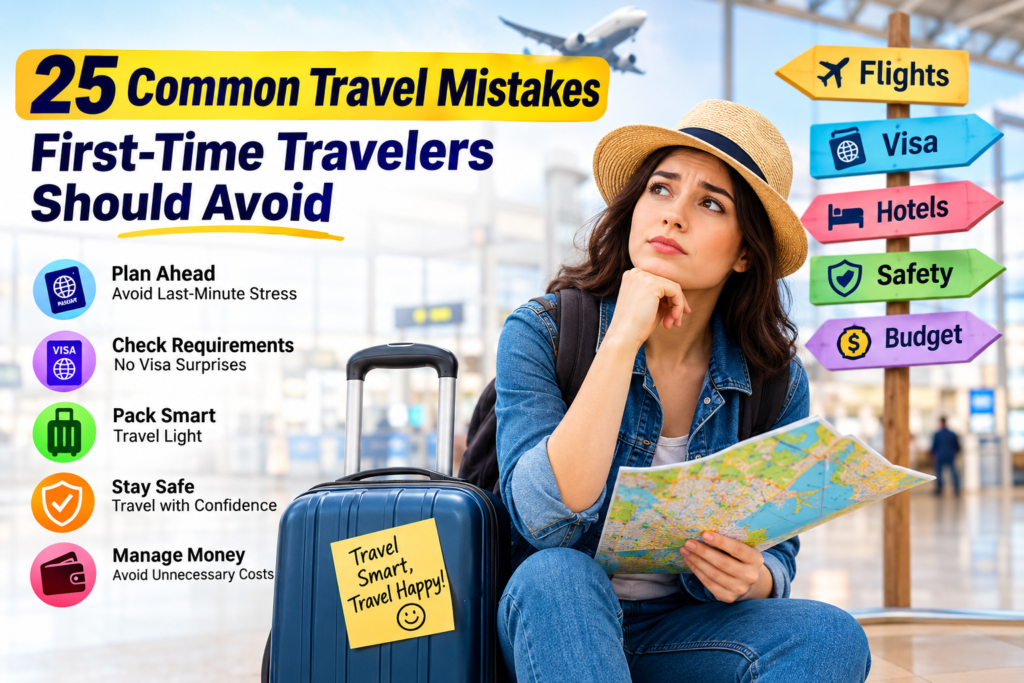
Your first trip is exciting, but it can also come with a few surprises. A missed connection, an overpacked suitcase, or a forgotten travel document can turn a simple journey into a stressful one. The good news is that most of these problems are easy to avoid with a little preparation.
In this guide, we’ll cover 25 common travel mistakes first-time travelers often make and, more importantly, what you can do to avoid them. From checking visa requirements to managing your money and planning your itinerary, these practical tips can help you travel with fewer surprises.
25 Common Travel Mistakes First-Time Travelers Should Avoid
1. Not Researching Your Destination
What is the mistake?
One of the easiest mistakes to make is arriving somewhere with no idea how things work locally. You may know the famous attractions, but what about getting around, local customs, weather, or even how much everyday expenses cost?
Why does it happen?
Travel photos and social media can make a destination look simple to navigate. The practical details are often left out.
Why is it risky?
Incomplete or inaccurate research can lead to unexpected expenses, cultural misunderstandings, and wasted time trying to find essential services after you arrive.
Practical Solution
Spend a few hours researching:
- Local transportation
- Currency
- Weather
- Emergency numbers
- Popular scams
- Cultural etiquette
Before you leave, spend some time checking local transportation, weather, currency, emergency information, and basic cultural etiquette.
Pro Tip: Bookmark official tourism websites before you travel.
2. Ignoring Visa and Entry Requirements
What is the mistake?
Many travelers assume that having a passport is enough to visit any country, only to discover at the last minute that a visa is also required for entry.
Why does it happen?
Entry requirements vary depending on your nationality and the country you plan to visit. These rules can also change over time, so it’s important to check the latest requirements before you travel.
Why is it risky?
If you do not meet the required visa requirements, you may be denied boarding or refused entry after arriving at your destination.
Practical Solution
Always check:
- Visa requirements
- Passport validity
- Immigration forms
- Transit visa rules
- Required travel documents
Do this several weeks before departure.
Pro Tip: Save digital copies of all your travel documents in secure cloud storage so you can easily access them whenever needed.
3. Booking Everything at the Last Minute
What is the mistake?
Waiting until the last minute to book flights, hotels, or activities is one of the most common and costly mistakes people make when planning a trip.
Why does it happen?
Some travelers keep delaying their bookings in the hope that prices will drop, while others simply keep putting off their travel plans.
Why is it risky?
Last-minute bookings often mean:
- Higher airfare
- Expensive hotels
- Limited availability
- Less flexibility
Practical Solution
Whenever possible, complete your major travel bookings and essential preparations several weeks or even months in advance.
Booking early usually offers the following benefits:
- Better prices
- More choices
- Easier cancellations
- Better seating options
Pro Tip: Before confirming your booking, compare prices across different travel websites to find the best available deal.
4. Overpacking Your Luggage
What is the mistake?
It’s tempting to pack for every possible situation, especially when it’s your first trip. The result is often a suitcase full of things you never use.
Why does it happen?
Many first-time travelers pack far more than they need, preparing for every possible situation with the mindset of “I might need it just in case.”
Why is it risky?
Heavy luggage can cause:
- Extra baggage fees
- Difficult airport transfers
- Physical strain
- Less space for souvenirs
Practical Solution
Pack versatile clothing that can be mixed and matched to create different outfits.
Create a packing checklist in advance and remove items you’re unlikely to use during your trip.
Roll your clothes instead of folding them to save space in your luggage.
Pro Tip: Before closing your suitcase, take out the last few things you added “just in case.” You probably won’t miss them.
5. Forgetting Travel Insurance
What is the mistake?
Many people skip travel insurance to save money, even though it can provide valuable protection against unexpected problems during a trip.
Why does it happen?
Many first-time travelers underestimate the risks of potential problems such as flight cancellations, medical emergencies, or lost luggage.
Why is it risky?
Unexpected medical treatment abroad can be extremely expensive.
Trip cancellations or lost luggage can also result in significant financial losses.
Practical Solution
Choose travel insurance that includes:
- Medical emergencies
- Trip cancellation
- Lost baggage
- Emergency evacuation
- Personal liability
Read the policy carefully before purchasing.
Pro Tip: Before choosing a travel insurance plan, compare not only the prices but also the coverage to make sure it meets your travel needs.
6. Not Checking Passport Validity
What is the mistake?
Many travelers discover too late that their passport is close to expiring.
Why does it happen?
Many people assume that having a valid passport is enough, without checking the entry requirements of their destination before traveling.
Why is it risky?
Many countries require your passport to remain valid for at least six months beyond your date of arrival.
If your passport does not meet this requirement, the airline may deny you boarding.
Practical Solution
Check your passport’s validity as soon as you start planning your trip.
If it is due to expire soon, renew it well in advance to avoid last-minute stress and complications.
Pro Tip: Store a scanned copy of your passport securely in cloud storage or another safe online location so you can easily access it whenever needed.
7. Ignoring Airline Baggage Rules
What is the mistake?
Every airline has its own baggage rules and luggage limits, but many travelers assume that all airlines follow the same baggage policy.
Why does it happen?
Low-cost airlines generally have stricter baggage rules than traditional full-service airlines.
Why is it risky?
Ignoring baggage rules can result in:
- Extra fees
- Airport delays
- Forced baggage check-in
- Repacking at the airport
Practical Solution
Review your airline’s baggage policy before packing.
Pay attention to:
- Carry-on dimensions
- Weight limits
- Restricted items
- Personal item rules
Pro Tip: Weigh your suitcase at home before leaving for the airport to avoid excess baggage fees and last-minute hassles.
8. Poor Budget Planning
What is the mistake?
Many first-time travelers fail to accurately estimate their day-to-day travel expenses.
Why does it happen?
Many travelers budget only for flights and hotels, but overlook additional expenses such as food, local transportation, tips, entrance fees, and shopping.
Why is it risky?
Running out of money during your trip not only causes unnecessary stress but can also prevent you from enjoying many worthwhile experiences.
Practical Solution
Create a realistic daily travel budget covering:
- Accommodation
- Food
- Transportation
- Attractions
- Shopping
- Emergency funds
Tracking expenses through a budgeting app also helps.
Pro Tip: Always keep a separate emergency fund or extra budget to handle unexpected situations during your trip.
9. Carrying Too Much Cash
What is the mistake?
Some travelers carry all the cash they need for their entire trip with them.
Why does it happen?
Many people assume that cash is accepted everywhere, or they prefer to avoid the extra fees associated with card payments.
Why is it risky?
If you lose your wallet, you could face serious financial difficulties for the rest of your trip.
If your cash is stolen, recovering it is usually almost impossible.
Practical Solution
Carry only enough cash for daily expenses.
Use a combination of:
- Credit cards
- Debit cards
- Mobile payments
- Emergency cash stored separately
Pro Tip: Instead of keeping all your cash in one wallet, divide it between different secure places so you still have access to money if one stash is lost or stolen.
10. Not Informing Your Bank
What is the mistake?
Many travelers forget to inform their bank before traveling abroad.
Why does it happen?
Many people assume that their bank cards will work automatically and without any issues in any country they visit.
Why is it risky?
Banks may temporarily block your card if they detect unusual transactions made in another country and suspect fraudulent activity.
If this happens, you may have difficulty accessing your own money during your trip.
Practical Solution
Before traveling:
- Inform your bank
- Check international transaction fees
- Confirm ATM availability
- Verify card expiration dates
Carrying at least two different payment methods provides greater security and peace of mind while traveling.
Pro Tip: Keep a backup credit or debit card in a secure place separate from your main wallet, so you can still make payments if your primary card is lost, stolen, or blocked.
11. Not Downloading Offline Maps
What is the mistake?
Many first-time travelers rely entirely on mobile data or public Wi-Fi to find their way around. While online maps are convenient, they may not work when there’s no signal or when you’re traveling in remote areas.
Why does it happen?
Most travelers assume they’ll always have access to the internet, especially in cities. However, poor network coverage, expensive roaming charges, or SIM card issues can sometimes leave you without reliable directions.
Why is it risky?
Getting lost in an unfamiliar place not only wastes valuable time but can also create safety concerns, especially if you are traveling alone or arriving at your destination late at night.
Practical Solution
Before leaving your hotel or airport:
- Download offline maps.
- Save your accommodation’s location.
- Mark nearby attractions and transport hubs.
- Keep a printed address of your hotel.
A few saved locations can save you a lot of trouble when your phone goes offline.
Pro Tip: Before your trip, save important places as “Favorites” or “Saved” in your map app so you can easily find them even when you’re offline.
12. Ignoring Local Scams
What is the mistake?
Every tourist destination has its own common scams that target visitors, but many first-time travelers don’t learn about them until they become victims themselves.
Why does it happen?
The excitement of exploring a new destination and being unfamiliar with the surroundings can make many travelers trust strangers who offer help, huge discounts, or cheap transportation.
Why is it risky?
Falling victim to a scam can lead to financial loss, theft of your belongings, and unnecessary stress throughout your trip.
Practical Solution
Before you travel, take some time to learn about the common scams at your destination. If someone approaches you with an offer that seems too good to be true, stay cautious.
Always use licensed taxis, official ticket counters, and reputable tour operators.
Pro Tip: Trust your instincts. If a person or situation feels suspicious, politely walk away.
13. Using Public Wi-Fi Without Protection
What is the mistake?
Using free Wi-Fi at airports, hotels, cafés, or shopping malls without taking proper security precautions.
Why does it happen?
Free internet is very convenient, especially if you want to avoid international roaming charges.
Why is it risky?
Using public Wi-Fi networks can expose your personal information, passwords, banking details, and private accounts to cybercriminals.
Practical Solution
Whenever possible:
- Use a trusted VPN.
- Avoid online banking on public networks.
- Disable automatic Wi-Fi connections.
- Turn off file sharing.
If you need to perform any sensitive online activity, use your mobile hotspot instead of connecting to public Wi-Fi.
Pro Tip: Before you travel, enable two-factor authentication (2FA) on all your important accounts to add an extra layer of security.
14. Not Learning Basic Local Phrases
What is the mistake?
Many travelers assume that everyone will speak English, no matter which country they are visiting.
Why does it happen?
English is widely spoken in many popular tourist destinations, which can lead travelers to assume that language will not be a major barrier.
Why is it risky?
Language barriers can make it difficult to communicate when ordering food, asking for directions, or seeking help in an emergency.
Practical Solution
Learn a few essential phrases, such as:
- Hello
- Thank you
- Please
- Excuse me
- Help
- Where is the restroom?
Even if your pronunciation isn’t perfect, locals will often appreciate the effort you make to speak their language.
Pro Tip: Download an offline translation app before your trip so you can translate easily even without an internet connection.
15. Forgetting Power Adapters
What is the mistake?
You may remember to pack your charger, but many travelers forget that power sockets and plugs can vary from one country to another.
Why does it happen?
Many travelers are unaware that different countries use different types of plugs and voltage standards.
Why is it risky?
Without the correct adapter, you may not be able to charge your:
- Phone
- Camera
- Laptop
- Power bank
Buying adapters at airports is often expensive.
Practical Solution
Before your trip, check which type of power plug is used at your destination and carry a universal travel adapter with you. If you’re traveling with multiple electronic devices, consider choosing a universal adapter with USB ports.
Pro Tip: Always keep your adapter in your carry-on bag so you can easily access and use it as soon as you arrive at your destination.
16. Skipping Health Precautions
What is the mistake?
Ignoring important health advice before traveling internationally.
Why does it happen?
Even healthy travelers often assume they don’t need vaccinations or health advice before traveling.
Why is it risky?
Health risks can vary from one country to another, including illnesses caused by contaminated food or water, mosquito-borne infections, and the need for certain vaccinations.
Practical Solution
Before traveling:
- Check recommended vaccinations.
- Pack essential medications.
- Carry a small first-aid kit.
- Purchase travel health insurance.
Always drink safe water and eat from reputable restaurants.
Pro Tip: Always keep your doctor-prescribed medications in their original packaging when traveling abroad.
17. Ignoring Local Weather Conditions
What is the mistake?
Packing for your trip without checking the latest weather forecast for your destination.
Why does it happen?
Travelers often assume the weather will be similar everywhere or rely on outdated weather information when preparing for their trip.
Why is it risky?
Unexpected rain, heat, or cold can disrupt your sightseeing plans and lead to unnecessary spending on extra clothing.
Practical Solution
Check the forecast several days before departure and pack accordingly.
Include clothing layers to prepare for changing weather conditions.
Pro Tip: Pack a lightweight, waterproof jacket—it can come in handy in almost any weather.
18. Not Making Copies of Important Documents
What is the mistake?
Traveling with only the original documents for your passport, visa, tickets, and travel insurance.
Why does it happen?
Many travelers assume that a digital airline confirmation is all they need for their trip.
Why is it risky?
If your passport or any important document is lost or stolen, having a backup copy can make the process of getting a replacement much easier.
Practical Solution
Keep:
- Printed copies
- Digital copies
- Cloud backups
Store them separately from the originals.
Pro Tip: Before leaving home, email yourself digital copies of all your important travel documents and keep them stored securely.
19. Planning an Overloaded Itinerary
What is the mistake?
First-time travelers often worry that they might miss out on an important place or a memorable experience.
Why does it happen?
First-time travelers often worry that they might miss out on an important place or experience.
Why is it risky?
An overly packed travel schedule can lead to several problems:
- More fatigue
- Less time to enjoy meaningful experiences
- Higher transportation costs
- Less enjoyment overall
Travel should be about enjoying each experience at a comfortable pace, not rushing from one place to another.
Practical Solution
Prioritize the places you genuinely want to visit, but also leave some time in your trip to discover new and unexpected things. Keep some free time in your schedule so you can enjoy local cafés, explore nearby neighborhoods, and make the most of spontaneous experiences.
Pro Tip: Whenever possible, leave one day of your trip completely unplanned, so you can relax at your own pace or have the chance to discover something new.
20. Ignoring Local Transportation Options
What is the mistake?
Many tourists rely solely on taxis because they seem like the easiest and most convenient option.
Why does it happen?
Using public transportation in a new city can sometimes feel a little confusing.
Why is it risky?
Taking a taxi everywhere can significantly increase your travel costs.
You may also miss out on experiencing local life and getting a real feel for the destination.
Practical Solution
Before your trip, take some time to learn about the transportation options available at your destination.
Consider options such as:
- Metro systems
- Public buses
- Trains
- Airport shuttles
- Bike-sharing services
- Walking routes
Many cities also offer tourist transportation passes that can help reduce your overall travel costs.
Pro Tip: Before your trip, download the official public transportation app for your destination so you can get around more easily once you arrive.
21. Not Respecting Local Culture
What is the mistake?
First-time travelers may sometimes overlook local customs, dress codes, or social etiquette without realizing it. Even when it isn’t intentional, this can still offend or upset local people.
Why does it happen?
Travelers often assume that cultural norms are the same everywhere or fail to learn about local customs and traditions before their trip.
Why is it risky?
Not respecting local customs can lead to uncomfortable situations, being denied entry to certain religious sites, or unpleasant experiences with local people.
Practical Solution
Before your trip, take some time to learn about the local customs and practices at your destination:
- Appropriate clothing
- Greeting customs
- Photography rules
- Local food and dining etiquette
- Religious traditions
Respecting local customs can make your trip more meaningful and enjoyable while also leaving a positive impression on the local community.
Pro Tip: If you’re unsure about local customs, observe how people around you behave and try to follow their lead.
22. Forgetting Emergency Contacts
What is the mistake?
Many travelers forget to prepare a list of important emergency contacts before leaving home.
Why does it happen?
People often assume that an emergency is unlikely to happen and rely entirely on their smartphones.
Why is it risky?
If your phone is lost, damaged, or runs out of battery, accessing important contact information can become difficult.
Practical Solution
Keep both digital and printed copies of all this important information with you:
- Family emergency contacts
- Local emergency numbers
- Hotel details
- Embassy or consulate information
- Travel insurance emergency hotline
Keep the printed copy in a safe place separate from your wallet.
Pro Tip: Save your emergency contacts as “Favorites” on your phone so you can access them quickly when needed.
23. Ignoring International Roaming Charges
What is the mistake?
Using your regular mobile plan abroad without checking the roaming charges first.
Why does it happen?
Many travelers assume that their current mobile plan includes affordable international data.
Why is it risky?
Unexpected roaming charges can significantly increase your travel expenses. Sometimes, even a short trip can result in a bill of hundreds of dollars.
Practical Solution
Before departure:
- Contact your mobile provider.
- Compare international plans.
- Consider purchasing a local SIM card or an eSIM.
- Use Wi-Fi whenever it’s safe and secure.
Monitoring your data usage also helps avoid surprise bills.
Pro Tip: Turn off automatic app updates while traveling to reduce background data usage.
24. Sharing Real-Time Travel Updates on Social Media
What is the mistake?
Sharing your live location and travel plans publicly while you’re away from home.
Why does it happen?
Travelers often enjoy sharing their exciting moments with friends and followers right away.
Why is it risky?
Public posts can reveal that your home is empty or show your current location, creating unnecessary risks to your safety and privacy.
Practical Solution
Consider sharing photos only after you’ve left a place or returned home.
Also, review your social media privacy settings and control who can see your travel-related updates.
Pro Tip: Focus on enjoying the experience first, and share the memories later.
25. Not Carrying Backup Payment Methods
What is the mistake?
Relying on just one credit or debit card for your entire trip.
Why does it happen?
Many first-time travelers assume that having just one payment method will be enough.
Why is it risky?
Your card could be lost, damaged, blocked by the bank, or suddenly declined. Without a backup, paying for hotels, food, or transportation can become difficult.
Practical Solution
Carry at least:
- One primary credit card
- One backup debit or credit card
- A small amount of emergency cash
Keep your backup payment options in a safe place separate from your main wallet.
Pro Tip: Instead of keeping all your money in one place, carry some emergency cash in a separate, secure spot among your belongings.
Conclusion
Your first trip doesn’t have to be perfect. A delayed flight, a wrong turn, or a forgotten item can happen to anyone. What matters is preparing for the problems you can reasonably avoid.
Before you leave, double-check your documents, money, connectivity, insurance, and itinerary. Once you arrive, stay aware of your surroundings, respect local customs, and give yourself enough time to enjoy the destination instead of rushing from one attraction to another.
Keep this list of common travel mistakes handy when planning your next trip. A little preparation before departure can save you a lot of unnecessary trouble once you’re on the road.
Frequently Asked Questions (FAQs)
1. What are the most common travel mistakes first-time travelers make?
First-time travelers most often run into problems with things like overpacking, poor budgeting, missing visa requirements, ignoring travel insurance, or trying to fit too much into a short itinerary.
2. How can I avoid travel planning mistakes?
Create a detailed travel checklist, make important bookings in advance, and carefully check your passport and visa requirements. Also, set a realistic budget and research the local transportation, weather, and customs before your trip.
3. Why is travel insurance important for first-time travelers?
Travel insurance can help cover unexpected situations such as medical emergencies, trip cancellations, flight delays, or lost baggage. It can reduce the financial risk you may face during your trip.
4. What are the best travel safety tips for international trips?
To stay safe while traveling, keep copies of your important documents, avoid using unsecured public Wi-Fi, carry backup payment options, learn about common local scams, and respect the local laws and customs.
5. What should every first-time traveler pack?
Along with your clothes, make sure to pack your passport, travel insurance documents, essential medications, a universal power adapter, a portable charger, a reusable water bottle, and copies of important travel documents.
Call to Action
Planning your first trip? Bookmark this guide and use it as a checklist before you travel.
If you found these tips helpful, share this article with friends and family who are preparing for their next trip. Do you have a travel lesson or experience that could help others? Leave a comment below and share your story with us—we’d love to hear it.
For expert packing advice, destination ideas, budgeting tips, and travel safety information, be sure to check out our other travel guides as well.